Lexigma
How to play:
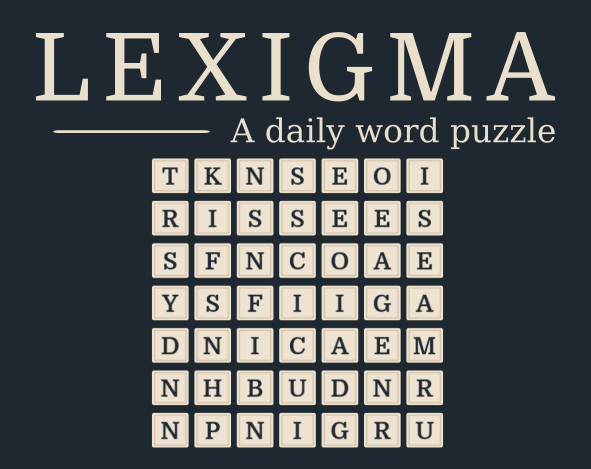
- Your goal is to discover all the hidden words in the grid.
- The grid contains all the letters of the words you must find.
- Drag letters to rearrange them and form words.
- A blue letter means the letter is in the correct position.
- An orange letter means the letter belongs to this position, but in a different word.
- A red letter means the letter is not in this correct position.
Comment jouer :
- Votre objectif est de découvrir tous les mots cachés dans la grille.
- La grille contient toutes les lettres des mots que vous devez trouver.
- Faites glisser les lettres pour les réarranger et former des mots.
- Une lettre verte signifie que la lettre est à la bonne position.
- Une lettre orange signifie que la lettre est à la bonne position, mais dans un autre mot.
- Une lettre rouge signifie que la lettre n'est à la bonne position.
Cómo jugar:
- Tu objetivo es descubrir todas las palabras ocultas en la cuadrícula.
- La cuadrícula contiene todas las letras de las palabras que debes encontrar.
- Arrastra las letras para reorganizarlas y formar palabras.
- Una letra verde significa que la letra está en la posición correcta.
- Una letra naranja significa que la letra pertenece a esta posición, pero en una palabra diferente.
- Una letra roja significa que la letra no está en la posición correcta.
So spielst du:
- Dein Ziel ist es, alle versteckten Wörter im Raster zu entdecken.
- Das Raster enthält alle Buchstaben der Wörter, die du finden musst.
- Ziehe Buchstaben, um sie neu anzuordnen und Wörter zu bilden.
- Ein grüner Buchstabe bedeutet, dass der Buchstabe an der richtigen Position ist.
- Ein orangefarbener Buchstabe bedeutet, dass der Buchstabe zu dieser Position gehört, aber in einem anderen Wort.
- Ein roter Buchstabe bedeutet, dass der Buchstabe nicht an der richtigen Position ist.
Comments
Log in with itch.io to leave a comment.
It's an interesting idea, but you should think about wordlists--the problem with using everything in Wiktionary is that not everything in Wiktionary is exactly a word. In the game I just played I had both JUDS (the plural of "A mass of coal holed or undercut so as to be thrown down by wedges.", which is...not a word most people will ever use, or see) and FANE (which is a surname).
yea I didn't have a single word in the one I just did that I knew...
bens - plural of Ben
vrot - (South Africa) rotten
caas - third-person singular simple present indicative form of caa
cava - Alternative letter-case form of Cava, a Catalan white sparkling wine.
itch is giving me the red squiggly line under vrot, caas, and caa....
It's definitely my highest thing to fix right now. I have learned lots of weird words will working on this :)
To be fair, "my personally curated word list" is the kind of thing a lot of crossword puzzle creators keep closely guarded, because it's hard to decide what words should or shouldn't "count", especially if you're planning to go through them one by one.
In theory, https://www.spreadthewordlist.com/ could help; it's an open-source curated word list. Since it's crossword focused, though, it probably does include things you'd accept as a crossword entry but not as a word in a puzzle that, like this one, doesn't use clues. (For instance, phrases like "UM NO", or uncommon proper names like "ELIA", which are things that you can write a clue for.) Also of course it's only in English.
Also potentially helpful, if you're a Pythonista, is the "wordfreq" package (https://github.com/rspeer/wordfreq), which lets you look up the frequency of words. If you have a too-long word list, it might be able to tell you that "vrot" and "caas" are rarer than you want your words to be. (Also has the advantage that it's hugely multilingual!)
Anyway--I'm leaving any comment at all because I love word games, and I love seeing more of them, and so I'm happy that you made this at all and would love to see it be as good as it can be! Keep up the good work!
Super interesting stuff. I am currently exploring a solution where I infer the word usage using the wikidictionary dump. Other solutions would be to make my own (or let user submitted a daily grid). I also want to try using some available word frequencies, but I need a solution that supports French, Spanish, German, etc.
wordfreq, if it's a thing you can use, definitely has information for French, Spanish, and German. (If you don't use Python, the data files are available in MessagePack format at https://github.com/rspeer/wordfreq/tree/master/wordfreq/data, which ought to be readable in the programming language of your choice.)
I know Elia, who wrote wordfreq, used wiktionary dumps for other projects, and I know there's useful data in there (I think among other things she was filtering out offensive words?), but I don't know much about it. Best of luck!